
If you have been diagnosed with treatment-resistant depression, your psychiatrist has likely mentioned two names: TMS and ketamine. Both are available at NeuPath Mind Wellness, both have strong clinical track records, and both are designed specifically for people who have not gotten adequate relief from standard antidepressants.
So how do you choose between them?
The honest answer is that there is no single right answer that applies to every patient. TMS and ketamine work differently, feel different, fit different lifestyles, and tend to suit different clinical profiles. What the right choice looks like depends heavily on your specific situation, your history, and what matters most to you.
This post will walk you through exactly how these two treatments compare so that when you sit down with a psychiatrist, you already have a solid foundation for that conversation.
How They Work: Two Completely Different Mechanisms
The first thing to understand is that TMS and ketamine are not variations of the same treatment. They are fundamentally different approaches to the same problem.
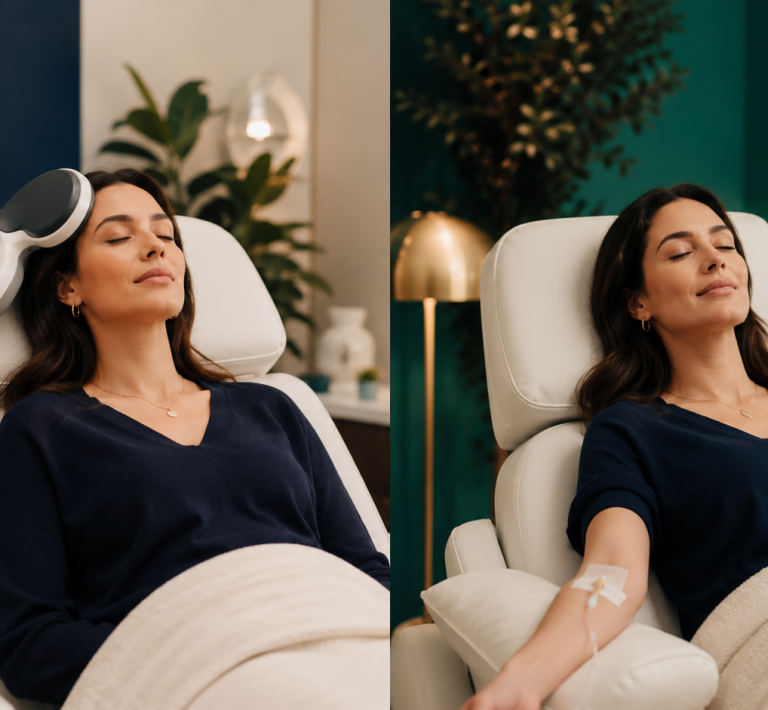
TMS, or Transcranial Magnetic Stimulation, uses focused magnetic pulses delivered through a coil placed gently against your scalp to stimulate the area of the brain responsible for mood regulation. You are fully awake throughout the session. There is no drug involved, no altered state, and no recovery time. TMS works through neuroplasticity, the brain’s ability to build and strengthen neural connections over time. Each session builds on the previous one, and the results develop gradually and durably over the course of treatment.
Ketamine works through an entirely different route. It is administered either as an IV infusion or, in the case of Spravato, as a nasal spray under clinical supervision. It works by blocking NMDA receptors in the brain and triggering a rapid surge in glutamate signaling, which jump-starts the growth of new synaptic connections. The antidepressant effect can appear within hours of the first session, which is one of ketamine’s most significant advantages.
The Speed Difference
This is often the most important factor for patients in the early stages of deciding.
Ketamine is one of the fastest-acting antidepressant treatments in existence. Many patients feel a meaningful shift in mood within 24 to 48 hours of their first infusion. For someone in the middle of a severe depressive episode, that speed can be genuinely life-changing.
TMS does not work that fast. The typical course runs four to six weeks, and most patients begin noticing improvement somewhere in the second or third week. The results build progressively rather than appearing quickly.
If you are in acute distress and need relief as soon as possible, ketamine has a clear advantage on this dimension. If your situation is serious but not a crisis, and you are willing to invest in a treatment course that builds steadily, TMS is a strong option.
What the Session Experience Is Like
The day-to-day experience of these two treatments is very different, and for many patients this matters as much as the clinical data.
A TMS session lasts between 19 and 37 minutes. You sit in a comfortable chair while a coil delivers a series of magnetic pulses to your scalp. You hear a clicking sound and feel a light tapping sensation. That is essentially the full experience. When the session ends, you drive yourself home, go to work, pick up your kids, or do whatever you had planned. There is no altered state, no impairment, and no recovery period needed.
A ketamine infusion is a different kind of session. IV ketamine is administered over about 40 to 60 minutes in a monitored clinical environment. Most patients experience a dissociative state during the infusion, a dreamlike, floaty feeling that some find deeply therapeutic and others find disorienting. After the infusion, you need a recovery period before you can leave and you cannot drive yourself home. Plan to have someone with you.
Neither experience is inherently better. Some patients find the ketamine infusion to be a meaningful, even profound experience that contributes to the therapeutic effect. Others strongly prefer the straightforwardness of TMS. Your lifestyle and preferences are legitimate factors in this decision.
Side Effects: What to Expect From Each
TMS has a minimal side effect profile. The most common complaints in early sessions are mild scalp tenderness and a light headache, both of which typically resolve within an hour and diminish after the first week as your scalp adjusts. There are no systemic side effects because TMS does not enter your bloodstream. Your sleep, appetite, sexual function, and cognitive performance are unaffected.
Ketamine can cause nausea, dizziness, and elevated blood pressure during or shortly after infusions. The dissociative experience, while tolerated well by most patients, is not comfortable for everyone. These effects are temporary and resolve after the session. Ketamine does not carry the long-term systemic side effects associated with antidepressants, but the in-session experience is more physically and perceptually intense than TMS.
How They Compare on Effectiveness
Both treatments work. The evidence base for each is substantial.
TMS achieves response rates of approximately 50 to 58 percent in patients with treatment-resistant depression, with remission in roughly 30 percent. Newer accelerated protocols have shown significantly higher numbers in clinical trials. Results tend to be durable, with many patients maintaining improvement for a year or more after completing a course.
Ketamine produces response rates in the range of 50 to 70 percent depending on the patient population and protocol. Its advantages are the speed of onset and the ability to rapidly interrupt a severe depressive episode. The main challenge with ketamine is that the effects can diminish over time without maintenance infusions, meaning some patients need periodic booster sessions to sustain their improvement.
One consideration worth noting: for patients who have tried ketamine and had a partial response, TMS can sometimes build on that improvement. And for patients who complete TMS and want to maintain their results or address a relapse, ketamine can serve as an effective bridge. The two treatments are not mutually exclusive at NeuPath, and in some cases a combined approach makes clinical sense.
The Insurance Question
This is a practical reality that affects many patients’ decisions.
TMS is frequently covered by insurance for treatment-resistant depression. Most major insurers, including Aetna, Blue Cross Blue Shield, Cigna, UnitedHealthcare, and Medicare, have established coverage policies for TMS. The standard requirement is that you have tried at least one or two antidepressants without adequate relief, which most patients seeking TMS have already done.
Ketamine infusion therapy is generally not covered by insurance because it is used off-label. The cost of a full course of IV ketamine infusions runs in the range of several thousand dollars out of pocket.
Spravato, the FDA-approved nasal spray form of esketamine, is the exception. It has a dedicated FDA approval for treatment-resistant depression and is typically covered by insurance under similar criteria to TMS.
If cost and insurance coverage are significant factors in your decision, TMS and Spravato have a clear practical advantage over IV ketamine infusions.
A Simple Framework for Deciding
Use this as a starting point, not a final answer. Your psychiatrist will help you refine it based on your full clinical picture.
Lean toward TMS if:
- You want a medication-free treatment with no in-session altered state
- You need to drive yourself to and from sessions and maintain your full daily routine
- Insurance coverage is a priority
- Your situation is serious but not an acute crisis requiring immediate relief
- You want durable results from a defined treatment course without ongoing maintenance
Lean toward ketamine if:
- You need fast relief from a severe or acute depressive episode
- You have tried TMS previously without sufficient improvement
- You are open to the in-session experience and have support for transportation
- You are willing to invest in treatment out of pocket or are using Spravato with insurance coverage
| Talk to Our Team Both TMS and ketamine therapy are available at NeuPath Mind Wellness across our three South Florida locations in Delray Beach, Boca Raton, and Boynton Beach. Our psychiatrists take the time to understand your history, your priorities, and your life before recommending a direction. If you have been living with depression that has not responded to medication and you are ready to try something that actually works, we are ready to have that conversation with you. Book a free consultation at NeuPath Mind Wellness today. |