
If anxiety has not responded to medication or therapy, it is natural to wonder whether TMS could help. The accurate answer has two parts. For anxiety that occurs alongside depression, there is an FDA-cleared use and supportive data. For anxiety on its own, the picture is much less settled.
This post separates what is established from what is still being studied.
What the FDA Has Cleared
In July 2022, the FDA cleared the NeuroStar TMS system to decrease anxiety symptoms in adults with major depressive disorder who also have anxiety symptoms, often called anxious depression. This was in addition to its existing clearance for depression.
It is important to be precise about what that clearance means. TMS is cleared for anxiety symptoms within depression. It is not cleared as a treatment for generalized anxiety disorder, panic disorder, or social anxiety on their own.
What the Evidence Shows for Anxious Depression
Anxious depression is common. It is estimated to affect more than half of people treated for major depressive disorder, and it is often harder to treat with medication.
The clearance was supported by real-world registry data. In the data submitted to the FDA, 65.5% of 664 patients with anxious depression had a clinically meaningful response. A later peer-reviewed analysis in the Journal of Clinical Psychiatry reviewed more than 1,800 patients and found large improvements in both anxiety (GAD-7) and depression (PHQ-9) scores.
These results are encouraging, but they have limits. They come from a real-world registry run by the device manufacturer, without a sham-treatment comparison group, so they cannot show how much of the improvement is due to TMS itself.
What About Anxiety Without Depression?
Research on TMS for anxiety disorders without depression is earlier and less consistent. Some clinicians use TMS off-label in these cases, but there is no FDA clearance for it, and anyone offering it should be clear about that.
For generalized anxiety, panic, or social anxiety on their own, well-established first-line treatments include cognitive behavioral therapy and medication such as SSRIs or SNRIs. If those have not helped, a psychiatrist can review other options with you, including whether anything in your history points to an underlying depression, PTSD, or OCD that is driving the anxiety. Our post on GAD vs. PTSD explains why getting that distinction right matters.
The FDA has cleared the NeuroStar TMS system to decrease anxiety symptoms in adults with major depressive disorder who have comorbid anxiety, often called anxious depression. TMS is not cleared for generalized anxiety disorder, panic disorder, or social anxiety on their own.
Research on TMS for anxiety without depression is earlier and less consistent, and there is no FDA clearance for it. Established first-line treatments include cognitive behavioral therapy and medications such as SSRIs and SNRIs.
Anxious depression is major depressive disorder that occurs together with significant anxiety symptoms. It is estimated to affect more than half of people treated for depression.
In real-world registry data, 65.5% of 664 patients with anxious depression had a clinically meaningful response, and a later analysis of more than 1,800 patients found large improvements in anxiety and depression scores. These data come from a manufacturer-run registry without a sham comparison group.
Who May Be a Candidate
TMS may be worth discussing if:
- You have depression with significant anxiety symptoms
- You have tried at least one antidepressant without enough relief
- You want a treatment that does not add medication
TMS is not suitable for everyone. Metal implants in or near the head, such as aneurysm clips or certain implanted devices, are a concern, and a history of seizures needs careful evaluation first.
What Treatment Looks Like
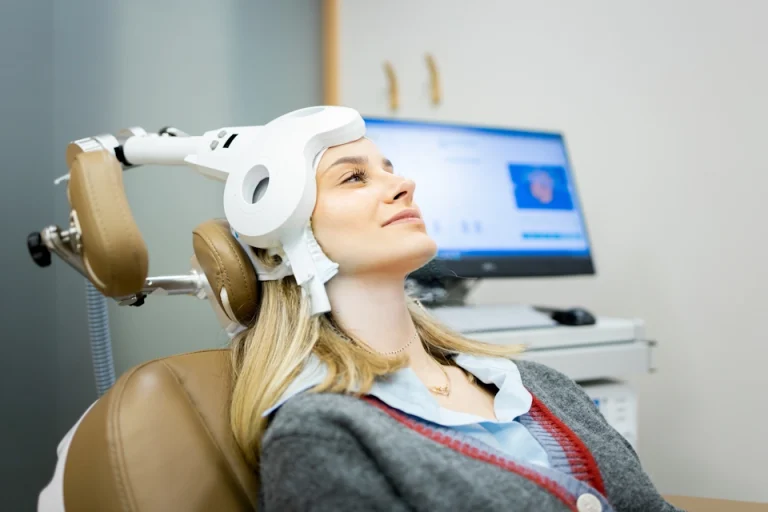
Standard TMS involves one session a day, about 36 sessions in total, over roughly seven weeks. You stay awake in a chair while magnetic pulses are delivered to your scalp. Most patients drive themselves home and return to normal activities right away. Common side effects are mild scalp discomfort and a light headache early on.
For patients who cannot commit to that schedule, NeuPath also offers One-Day TMS, an accelerated protocol completed in a single treatment day. It is typically not covered by insurance and is FSA and HSA eligible.
Insurance Considerations
TMS coverage is generally tied to a diagnosis of depression and a history of medication trials. TMS for anxiety alone is typically not covered. Because policies vary, our team verifies your benefits and handles authorization before treatment begins.
TMS coverage is generally tied to a depression diagnosis and prior medication trials. TMS for anxiety alone is typically not covered. NeuPath verifies your benefits before treatment.
Standard TMS is about 36 sessions, one a day, over roughly seven weeks. NeuPath also offers One-Day TMS, which is typically not covered by insurance and is FSA and HSA eligible.
People with metal implants in or near the head, such as aneurysm clips or certain implanted devices, are generally not candidates. A history of seizures requires careful evaluation.
Start with a free 15-minute discovery call and a comprehensive evaluation at NeuPath. Your psychiatrist will review your history and recommend a plan.
| Anxiety Care at NeuPath |
|---|
| NeuPath’s psychiatrists evaluate anxiety in the context of your full history, including depression, trauma, and OCD, then recommend the treatments that fit. That may include medication management, TMS, or other options. |
| Schedule a free 15-minute discovery call to talk through your situation. |