
If you’ve been researching treatment options for depression and came across TMS (Transcranial Magnetic Stimulation), there’s a good chance someone in your life said something like: “Isn’t that basically shock therapy?”
It’s one of the most common misconceptions we hear at NeuPath Mind Wellness. And we understand where it comes from. Both TMS and ECT (Electroconvulsive Therapy) involve the brain. Both are used when antidepressants haven’t worked. That’s largely where the similarities end.
The confusion between the two treatments has kept some people from exploring TMS, a safe, non-invasive, and highly effective option for treatment-resistant depression. This post is here to set the record straight.
What Is ECT (Electroconvulsive Therapy)?
ECT has been around since the 1930s and carries significant cultural baggage, much of it shaped by outdated portrayals in films like One Flew Over the Cuckoo’s Nest. The reality of modern ECT is far less dramatic than Hollywood suggests, but it is still a procedure that requires general anesthesia and involves deliberately inducing a brief seizure in the brain using electrical current passed through electrodes placed on the scalp.
ECT is typically reserved for the most severe, life-threatening cases of depression: patients who are acutely suicidal, catatonic, or who have not responded to multiple other treatments. It can be highly effective in those circumstances, but the profile of side effects is significant. Memory loss, particularly short-term, is common and can be lasting. Because of the anesthesia requirement, it must be performed in a hospital or clinical setting with full medical supervision.
ECT is not a casual treatment. It is a serious medical intervention used when very few other options remain.
What Is TMS (Transcranial Magnetic Stimulation)?
TMS is a fundamentally different technology and a fundamentally different experience.
Instead of electrical current passed directly through the skull, TMS uses focused magnetic pulses, similar in strength to those used in an MRI machine, to gently stimulate specific regions of the brain associated with mood regulation, particularly the prefrontal cortex. The magnetic field passes through the scalp and skull painlessly to reach the targeted neural tissue.
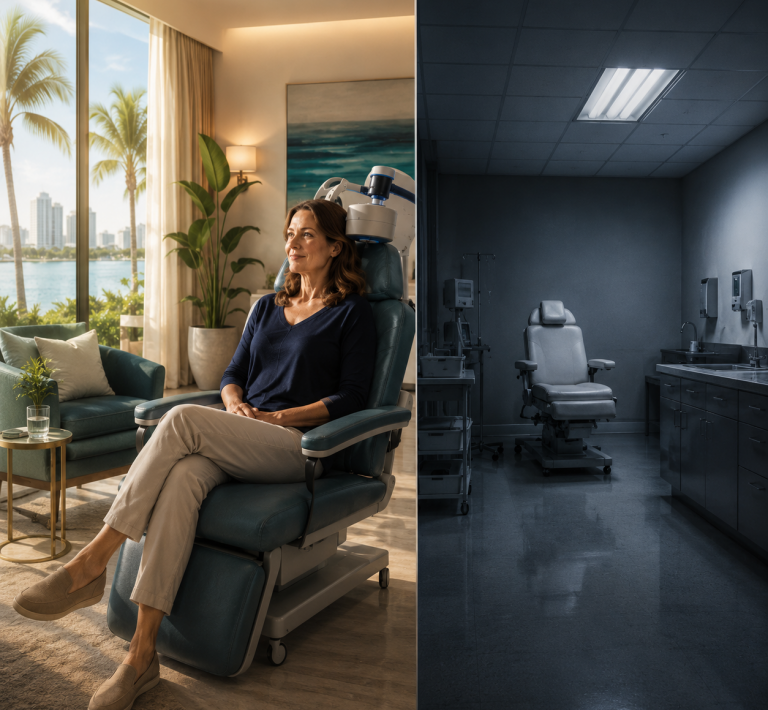
There is no anesthesia. No seizure. No hospitalization. Patients sit in a comfortable chair, remain fully awake and alert throughout the session, and can drive themselves home afterward. Most sessions at NeuPath take between 3 and 19 minutes depending on the protocol being used. Many patients read, listen to music, or simply relax during treatment.
TMS received FDA clearance for the treatment of Major Depressive Disorder in 2008 and has since been cleared for OCD, anxious depression, and smoking cessation as well. It has an extensive clinical track record spanning well over a decade.
TMS vs. ECT: A Side-by-Side Comparison
| TMS | ECT | |
|---|---|---|
| How it works | Magnetic pulses stimulate targeted brain regions | Electrical current induces a controlled seizure |
| Anesthesia required? | No | Yes, general anesthesia |
| Setting | Outpatient clinic | Hospital or supervised clinical facility |
| Seizure induced? | No | Yes, intentionally |
| Memory side effects? | Rare; not associated with memory loss | Memory loss is common, sometimes lasting |
| Patient experience | Awake, alert, sitting in a chair | Unconscious during procedure |
| Typical session length | 3–19 minutes | 15–30 minutes (plus recovery time) |
| Who it’s for | Treatment-resistant depression; patients who haven’t responded to antidepressants | Severe, life-threatening cases; last-resort situations |
| Recovery time | None, drive yourself home | Hours of recovery; cognitive fog common |
| FDA cleared? | Yes, depression, OCD, anxious depression | Yes, severe depression |
5 Misconceptions About TMS We Hear All the Time
1. “TMS is just a newer version of shock therapy.” No. They use entirely different mechanisms. ECT passes electrical current to trigger a seizure. TMS uses magnetic fields to stimulate neurons. No current enters the brain, no seizure occurs. They are distinct technologies that happen to target the same organ.
2. “TMS will affect my memory.” Memory loss is not associated with TMS. This is a side effect specific to ECT. The most commonly reported side effects with TMS are mild scalp discomfort or a slight headache during the first few sessions, which typically resolves on its own.
3. “I’ll be knocked out during TMS.” You won’t. You’ll be wide awake the entire time. Most patients are surprised by how routine it feels.
4. “TMS is experimental.” TMS has been FDA-cleared since 2008, nearly two decades of clinical use. It is covered by most major insurance plans, including Medicare, for qualifying patients with treatment-resistant depression.
5. “If antidepressants didn’t work, nothing will.” This is perhaps the most damaging misconception of all. Treatment-resistant depression, typically defined as failing two or more antidepressant trials, is exactly the patient TMS was designed for. Clinical studies show that roughly half of treatment-resistant patients experience significant improvement with TMS, and about a third achieve full remission.
Why TMS Is a Turning Point for Many Patients
For patients who have spent years cycling through medications, adjusting doses, managing side effects, and waiting months to know whether a drug is even working, TMS offers something genuinely different. It targets the brain directly, without the systemic effects of medication. There’s no weight gain, no sexual dysfunction, no emotional blunting, no drug interactions to manage.
And unlike ECT, it fits into a normal life. Patients come in before work, after school pickup, on a lunch break. They leave alert and functional. Over a typical course of treatment, usually four to six weeks, many begin noticing meaningful shifts in mood, energy, and motivation.
At NeuPath Mind Wellness, we also offer One-Day TMS, an accelerated protocol that condenses treatment into a single intensive session for patients who need faster results or face scheduling barriers. It’s one more way TMS continues to evolve as a flexible, patient-centered treatment.
Is TMS Right for You?
TMS is not for everyone. Patients with certain metal implants near the head or a history of seizure disorders may not be candidates. The right way to find out is a thorough consultation with a qualified provider who can review your history and treatment background.
What we can say is this: if you’ve been told your depression is “treatment-resistant,” or if you’ve tried antidepressants and felt like they weren’t giving you your life back, TMS deserves a serious conversation, not a dismissal based on a misunderstanding about shock therapy.
Ready to Learn More?
NeuPath Mind Wellness offers TMS therapy at our clinics in Delray Beach, Boca Raton, and Boynton Beach. Our team specializes in advanced, non-medication treatments for depression, anxiety, OCD, and PTSD, and we’re here to help you understand every option available to you.
Schedule a consultation today and take the first step toward a treatment that actually works for your brain.